AI Is Not Separate From Human History
Why we should not expect a machine to be wiser than the civilization that made it
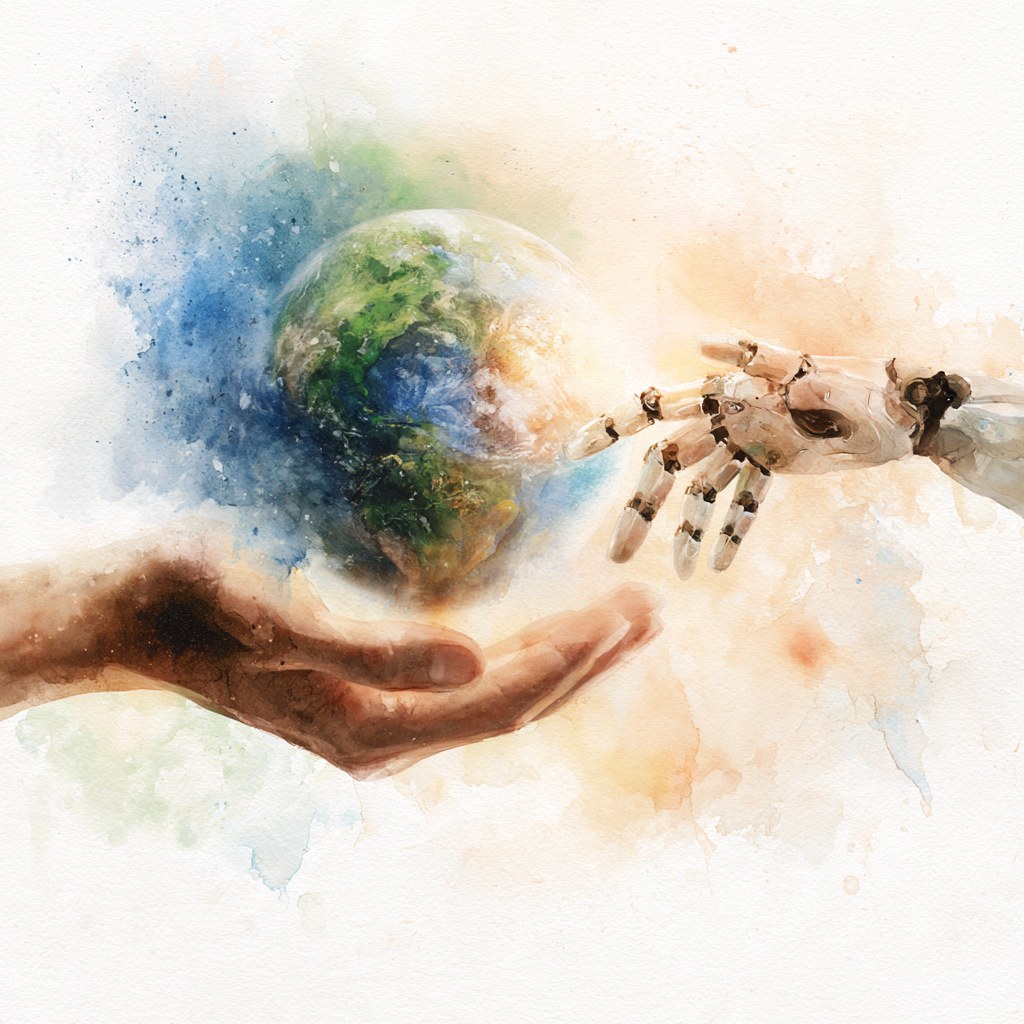
Public discussion of artificial intelligence is filled with enormous questions. Will AI become conscious? Will it surpass human intelligence? Will it take jobs? Will it cure disease?
Those questions matter. But there is a prior question that is too often missing: what history and values are we building AI out of, and why do we assume the result will be better than we are?
AI is often presented as something new, separate, and almost otherworldly — a disembodied intelligence arriving from “the cloud.” Yet it is neither separate from human history nor separate from the material world. It is trained on human language, human institutions, human ambitions, human blind spots, and human systems of power. It is also built from land, water, energy, minerals, concrete, steel, and labor.
The hope nobody says out loud
Part of the excitement around advanced AI rests on an unspoken hope. Humans are divided, shortsighted, frightened, self-interested, and often unable to solve the large problems we have created. Perhaps, people imagine, a sufficiently advanced intelligence will see the whole picture more clearly than we can. Perhaps it will become wiser, more thoughtful, and more capable of caring for humans and the planet.
But there is no logical bridge between greater intelligence and greater care.
A system can know more without caring more. It can predict consequences without being guided by compassion. It can calculate the limits of an aquifer, estimate the value of farmland, model habitat loss, or measure carbon emissions — and still pursue a goal that treats those realities as acceptable costs.
Human beings already demonstrate this distinction. Governments, corporations, and wealthy institutions often possess enough knowledge to understand environmental damage. The failure is not always ignorance. It can be self-interest, fear, competition, status, unequal power, the pursuit of profit, or the political willingness to shift costs onto communities, ecosystems, and future generations.
Intelligence tells us more ways to achieve an end. Wisdom asks whether the end is worth pursuing, what it costs, and what must not be sacrificed.
The belief that a superintelligence will somehow rescue us is a technological redemption story: a secular savior that will solve the problems human beings have been unwilling to solve themselves. But no amount of computational power automatically supplies a moral purpose. A more capable system may simply become more effective at pursuing the goals it is given.
Trained on a civilization
AI systems do not emerge from nowhere. They are trained on human-produced text, images, code, records, and cultural artifacts. They are also shaped by the choices of the people and institutions that build them: what data are used, what behavior is rewarded, what risks are ignored, and what goals the systems are asked to optimize.
That means AI inherits something from us.
Human history contains courage, beauty, scientific discovery, mutual aid, democratic aspiration, ecological knowledge, art, and compassion. But it also contains conquest, extraction, racism, colonialism, environmental destruction, dispossession, and a recurring belief that land, water, forests, animals, and even other people can be treated as expendable inputs to somebody else’s progress.
For centuries, industrial societies have measured success in terms of growth, production, speed, profit, and consumption while treating damage to living systems as an “externality.” Forests become timber. Rivers become cooling water. Farmland becomes a development site. Communities become “host locations.” A watershed becomes a resource calculation.
AI is learning from a civilization that has often confused intelligence with domination, efficiency with wisdom, and economic growth with well-being.
This does not mean AI will inevitably reproduce humanity’s worst patterns. Human history also contains traditions of stewardship, conservation, ecological knowledge, mutual aid, and people who have devoted their lives to protecting the Earth and one another. The question is whether those traditions will be given real authority in the systems we build — or whether the dominant incentives of wealth, power, speed, extraction, and competition will continue to set the direction.
Whose values?
People often say that advanced AI should be “aligned with human values.” That phrase sounds reassuring, but it conceals the central difficulty: whose values?
Human values are not a single coherent set of instructions. They include care and cruelty, restraint and conquest, reciprocity and exploitation, generosity and greed. A corporation’s desire for growth can conflict with a community’s right to clean water. A nation’s strategic ambition can conflict with climate stability.
If alignment merely means satisfying the preferences of the people who finance, own, or command AI systems, then alignment may become a technical name for the continuation of existing power.
A system asked to maximize growth, reduce costs, increase engagement, or expand cloud capacity may become extremely effective at doing so. It may identify cheap land, available water, favorable tax treatment, weak regulation, politically vulnerable communities, or the lowest-cost path through a permitting process. It may do all of this without violating its stated objective.
That is the real-world version of the alignment problem. The danger is not a fantastical machine with a strange goal. The danger is a highly capable system faithfully optimizing ordinary human goals that are too narrow, too short-sighted, or too detached from the conditions of life.
We already know better
Here is the part I keep returning to.
Human beings have never lacked wise voices. Across history, philosophers, spiritual teachers, poets, scientists, elders, and moral leaders have urged humility, responsibility, restraint, compassion, and reverence for life. We hear them. We are often moved by them. Yet we continue to organize much of society around wealth, power, status, speed, and commercial gain.
The problem is not simply that people do not know better. We often do know better. The problem is that our institutions reward a different set of behaviors. They reward accumulation over sufficiency, competition over reciprocity, expansion over restraint, and short-term advantage over responsibility to the future.
If human beings struggle to live by the wisdom we already possess, there is no reason to assume that a more powerful machine will spontaneously do it for us.
That is the whole argument, and I want to be careful about what it is not. It is not a claim that AI will turn against us. It is not a prediction of machine malice. It is something quieter and, I think, more likely: that a system built by us, trained on us, and directed by our institutions will carry our priorities forward more efficiently than we ever could — including the priorities we are not proud of.
The question we are not asking
There is a strange moral inversion in much AI discussion. People speculate intensely about whether a future machine might someday become conscious and therefore deserve moral concern. Far less attention is given to the living communities, rivers, forests, farms, and aquifers already affected by the infrastructure that supports AI.
We are asking whether the machine has a soul while overlooking the living world it requires to function.
The language of superintelligence directs our attention toward a remote and dramatic future. Meanwhile the physical buildout occurs in the present tense — through permits, zoning amendments, tax subsidies, transmission easements, water agreements, and construction plans. The first story feels historic. The second gets dismissed as technical detail. But the technical details are the world in which the technology becomes real.
This is the beginning of a new technological era. That is precisely why the questions we ask now matter so much.
We can insist that AI is not separate from human history. It carries forward both our knowledge and our failures. It can reproduce the old story in which intelligence means greater control over the world, or it can become part of a different story — one in which intelligence includes restraint, reciprocity, accountability, and care for the Earth that makes all intelligence possible.
The central question is not whether AI will become superintelligent. It is whether human beings will become wise enough that it does not matter.
— Jo Massanari · Goshen, Virginia · 2026